
In the fast pace of modern life, maintaining a deep connection with your partner is often harder than it looks. But the real secret isn't grand gestures — it's the questions you ask.
In 1997, psychologist Arthur Aron published a landmark study in the Personality and Social Psychology Bulletin showing that a structured series of progressively personal questions could significantly accelerate emotional intimacy — even between complete strangers. His famous "36 Questions" are divided into three escalating levels, proven to foster trust and closeness in as little as 45 minutes. This isn't magic. It's scientifically grounded vulnerability that builds stronger bonds.
As couples grow together, the challenge isn't running out of things to say — it's forgetting how to ask the questions that actually matter. Small talk fades over time, and without intentional effort, deeper conversation quietly stalls. That's where the right questions come in.
Why Questions for Couples Matter More as Relationships Grow
As intimacy deepens, couples sometimes find themselves in a strange place — not without words, but unsure how to begin. Even long-term partners may have many unexplored corners of each other's inner world. Research consistently shows that intentional questioning and active listening significantly enhances closeness in relationships.
The core insight from Aron's work: real emotional connection comes from a willingness to explore and ask. As a relationship matures, conversation shouldn't stay at the surface. Open, context-rich questions guide both partners toward deeper understanding and resonance — and the act of asking communicates that you still want to know.
Dr. John Gottman, who has spent over 40 years studying couples at his "Love Lab" at the University of Washington, found that one of the clearest predictors of relationship success is what he calls "love maps" — the detailed mental model each partner holds of the other's inner world. Couples who regularly update their love maps through conversation are significantly more resilient to stress, conflict, and time. They don't just know each other from the beginning; they keep learning each other as they both grow and change.
The practical implication: you can't maintain a love map through logistics ("Did you call the plumber?") or small talk alone. You need questions that actually reach inside.
The 3 Conversation Traps That Kill Couple Connection
Before we get to the questions, it helps to name the patterns that make couple conversation feel flat or forced — because recognizing them is the first step to avoiding them.
Trap 1: Parallel Updates Instead of Real Exchange
Many couples spend their time together exchanging life management updates — what happened at work, what the kids need, what needs to get done. This isn't conversation in the meaningful sense; it's maintenance. It keeps the household running but doesn't deepen connection. When every conversation is about logistics, partners gradually start to feel more like roommates than intimates.
Trap 2: Assuming You Already Know
"I already know what they'll say" is one of the most common reasons couples stop asking each other questions. But people change constantly — their fears, ambitions, opinions, and inner worlds shift over months and years. A partner you've been with for five years is still, in many ways, a person you're still discovering. Assuming otherwise leads to conversations that feel stale because they are.
Trap 3: Confusing Comfort With Closeness
Comfort is valuable — it's one of the best things about a long relationship. But comfort can quietly replace closeness if it's not tended. When two people stop surprising each other, stop revealing new things about themselves, and stop asking what's happening beneath the surface, the relationship becomes warm and safe but no longer growing. The questions below are designed to break that pattern without disrupting the comfort.
Fun Icebreaker Questions for Couples
These light-hearted questions are an ideal way to open conversation. Whether in everyday moments or special ones, they quickly close distance and set the stage for deeper exchange. No pressure — just laughter and play.
Icebreaker questions for long-term couples serve a different function than they do for strangers. For strangers, they reduce the awkwardness of not knowing someone. For couples, they do something subtler: they temporarily lift the weight of familiarity and routine, creating a moment of levity where two people remember they're also two people who like each other, find each other interesting, and can surprise each other.
Don't underestimate how much that matters. Research on positive sentiment override — the buffer that allows couples to interpret each other charitably during conflict — shows it's built largely through positive, lighthearted interactions. Fun questions aren't frivolous. They're building materials.
- If you could choose any superpower, what would you pick and why?
- What was your favorite toy as a child?
- If you could have dinner with any celebrity, who would you choose?
- What never fails to make you laugh out loud?
- What's your favorite travel destination?
- If you woke up tomorrow and discovered you'd switched genders, what's the first thing you'd do?
- What's your favorite song, and why that one?
- If you could instantly master one new skill, what would it be?
- What do you miss most about your school days?
- If your life were a movie, what would the title be?
- What's the most useless piece of trivia you know by heart?
- If you had to eat one meal every day for a year, what would you pick?
- What's something you believed as a kid that turned out to be completely wrong?
The best icebreaker conversations don't end with the answer — they begin there. "If your life were a movie, what would the title be?" invites a short creative answer, but it also opens the door to something more: why that title? What's the tone of the movie? Is it a comedy, a thriller, or something still being written? Following the answer is where the real conversation lives.
Want more spontaneous starters? Get random questions for couples on RandomQ — one tap, no sign-up needed.
Deep Questions for Couples: Emotions & Values
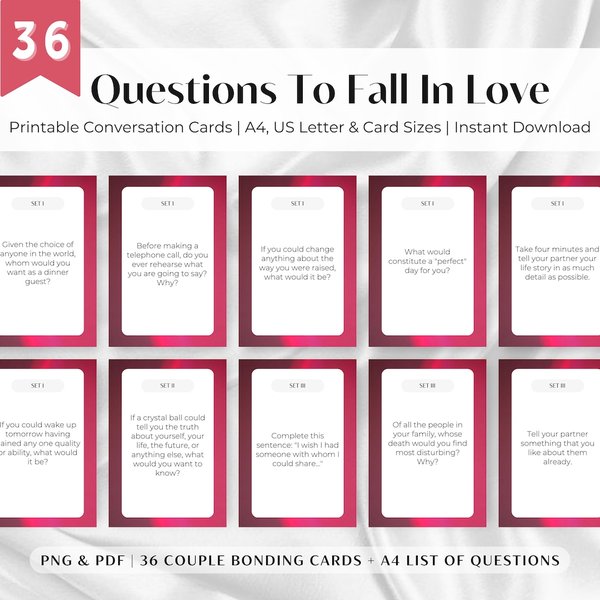
These questions go deeper — into feelings and core values. Split across two layers: emotional intimacy and the beliefs that shape a life. Use them on a quiet evening to build real trust.
Emotional intimacy questions require something from both partners: the courage to be honest, and the safety to hear honesty without judgment. If you're using these for the first time, start with something like question 18 ("What small gestures make you feel consistently warm and cared for?") — it's emotionally open without being heavy, and the answers often lead naturally into deeper territory.
Values questions are particularly important for long-term couples navigating major life transitions. How you think about money, family, and success shapes almost every significant decision you'll ever make together. Couples who've never discussed these openly are often surprised to discover meaningful differences — and often more surprised to find that talking about them is actually connecting rather than divisive.
Emotional Intimacy
- When do you feel most loved and appreciated?
- Is there anything that makes you feel especially anxious or unsettled?
- What do you value most in our relationship?
- When you're feeling down or lost, how do you hope I'll support you?
- What moment between us do you still remember most vividly?
- Do you have any secret wishes or dreams that haven't come true yet?
- How do you approach conflict — and how do you hope we handle disagreements?
- What small gestures make you feel consistently warm and cared for?
- What do you think is the key ingredient in a healthy relationship?
- Is there a version of yourself you're still becoming that you haven't told me about?
Question 17 ("When you're feeling down or lost, how do you hope I'll support you?") is one of the most practical relationship questions in existence. Different people need fundamentally different things when they're struggling — some want to be held and reassured, others want space; some want problem-solving, others want to be heard. Mismatches here cause enormous frustration in relationships, and simply asking the question can prevent years of misunderstanding.
Question 23 — "Is there a version of yourself you're still becoming that you haven't told me about?" — is one of the most powerful questions on this list. It gives your partner explicit permission to be someone they haven't fully become yet. In long relationships, people sometimes suppress parts of themselves because they feel too changed from the person their partner fell in love with. Asking this question opens a door that many couples never realize has been closed.
Core Values
- What's your personal motto or life philosophy?
- How do you think about money — are you more drawn to saving or spending?
- What do you think is the most important goal a person can have?
- How do you define "success"?
- How do you balance work and personal life?
- How central is family to how you live your life?
- What does "happiness" actually mean to you?
- If you could change one thing about the world, what would it be?
- What's a belief you hold that most people around you don't share?
Question 27 ("How do you define success?") deserves time and real attention. Two people can define success in completely incompatible ways — one prioritizes career achievement, the other prioritizes time freedom; one wants financial security, the other values experiences over accumulation. These differences aren't dealbreakers, but they become significant over time if they're never acknowledged.
Try deep conversation questions for couples in RandomQ's Deep mode — emotionally honest prompts in a late-night UI built for exactly this.
Romantic Questions for Couples
These questions focus on closeness, shared memories, and appreciation — ideal for reigniting a spark. Perfect for an anniversary or a quiet night in. Use them to revisit what's beautiful about what you've built.
Romantic questions are often overlooked in long-term relationships because couples assume they already know the answers. But here's what's interesting: the act of asking, and the act of hearing someone articulate appreciation for you out loud, has a measurable effect on relationship satisfaction. Research on gratitude in relationships shows that expressing it explicitly — not just feeling it, but saying it — significantly increases both partners' reported closeness.
These questions create space for that. They're not just nostalgic — they're an active form of appreciation.
- Do you still remember what our first date was like?
- When did you first realize you had feelings for me?
- What moment in our relationship have you found most romantic?
- What are three qualities you love most about me?
- In your eyes, what's the most beautiful picture of us together?
- Is there something we've done together that felt especially wonderful?
- If we could relive one moment in our relationship, which would you choose?
- Is there something you've been wanting to thank me for?
- What about me has genuinely surprised you over time?
- When do you feel most comfortable and at ease with me?
- Is there something you've always wanted to do and hope we can do together?
- If I wrote you a love letter, what would you want it to say?
- What small detail makes you feel my love most clearly?
- What's something you admire about me that you don't say often enough?
Question 41 — "What about me has genuinely surprised you over time?" — is one of the most valuable romantic questions here. Surprise in a long relationship is a signal of growth — it means your partner is still someone you're discovering. The answers to this question tend to be specific and unexpected in ways that generic compliments never are.
Future Planning Questions for Couples
These practical, forward-looking questions help align goals — from travel to family. Use them to sketch the blueprint of a life you're both building.
Future conversations can feel high-stakes, especially when they touch on big decisions — children, finances, where to live, career choices. But framing them as questions rather than negotiations changes the dynamic significantly. You're not trying to reach an agreement right now; you're trying to understand each other's current thinking and hopes. That's a very different, much gentler conversation.
The best time to have these conversations is when nothing is immediately on the line — when you're relaxed, not in the middle of a decision, and there's no pressure for the conversation to resolve something. That's when people are most honest.
- What are you most looking forward to in our future together?
- Five years from now, what do you hope we look like as a couple?
- What are our most important short-term and long-term goals?
- How do you think we should prepare for the future we want?
- If we could travel anywhere together, where would you most want to go?
- How do you hope we grow and keep learning together?
- What are your thoughts on how we handle money as a couple?
- How do you want to balance personal ambitions with shared life?
- What relationship in our lives do you think we need to invest in most?
- Is there a version of our life together that you dream about but haven't said out loud?
Question 56 is deliberately the last. It's an invitation to be vulnerable in a specific way — to share something hoped for but not yet spoken. In long relationships, unsaid dreams are common. Not because people are hiding them, but because there's never quite been the right moment to say them out loud. This question creates that moment.
How to Use These Questions
Bedtime ritual. End the day by putting phones down and asking each other one or two deep or romantic questions. Keep it low-pressure — the goal is connection, not therapy. Even 10 minutes of genuine conversation before sleep has a measurable effect on morning mood and relationship satisfaction, according to research on positive couple interactions.
Road trips. Long drives are underrated for conversation. You're side by side rather than face to face, which makes people naturally more open. Psychologists have noted that indirect face-to-face contact (like sitting beside someone in a car) often produces more honest conversation than direct eye contact, which can feel evaluative. Rotate through categories as the miles pass.
Date night. Instead of small talk, let the questions be the main event. Prepare a few future-focused ones for dinner, listen fully, share honestly. Every date night becomes a chance to know each other a little better. You don't need a special occasion — the intention to connect is occasion enough.
RandomQ's couples conversation questions give you one random prompt per tap — no account needed, works anywhere.
Building a Conversation Habit: The Weekly One-Question Method
The most sustainable way to use these questions isn't in a single marathon session — it's in small, consistent moments. Research from the Gottman Institute shows that couples who maintain "love maps" — an ongoing knowledge of each other's inner worlds — are significantly more resilient to conflict and disconnection.
Here's a simple structure that works:
Morning (1 minute): Ask one light question before your day begins — something from the icebreaker category. It sets a collaborative, curious tone for the day without requiring emotional availability you may not have yet.
Evening (5–10 minutes): This is where the deeper questions live. Ask one emotional or values question while you're winding down. No phones, no screens. You're not solving a problem — you're just learning something new about the person you're building a life with.
Weekly (20–30 minutes): Pick a category and go deeper. A dedicated conversation date — even over takeout at home — gives you space for questions about the future, long-held dreams, or things that have been on your mind. The Gottman Institute recommends spending at least 5 hours per week in focused positive connection with your partner; dedicated conversation is one of the most efficient ways to do that.
The key is consistency over intensity. You don't need to ask 10 questions every night. One good question, followed by genuine listening and honest sharing, does more than ten questions fired in rapid succession ever could.
What Each Type of Question Does
| Question Type | Main Purpose | Best Moment | Relationship Benefit |
|---|---|---|---|
| Fun / Icebreaker | Lighten the mood, break routine | Anytime | Reduces tension, creates shared laughter |
| Emotional | Explore inner feelings, build understanding | Quiet evenings | Builds empathy and emotional connection |
| Values | Understand core beliefs, align direction | Before big decisions | Reduces future conflict, creates shared meaning |
| Romantic | Revisit memories, express love | Date nights, anniversaries | Reignites closeness, expresses gratitude |
| Future Planning | Coordinate goals and dreams | Life transitions | Builds a shared vision, clarifies direction |
The Science: Arthur Aron's 36 Questions
Psychologist Arthur Aron's "36 Questions" is a landmark study demonstrating that even strangers can build profound emotional closeness through a series of progressively personal questions. The key is escalation — questions start at the surface, then gradually move toward the personal and vulnerable, encouraging participants to share their real selves.
This video explores Dr. Aron's findings in depth — how a series of increasingly personal questions can effectively accelerate intimacy. The research shows this works not just for new couples, but for any two people wanting to deepen a connection. The core mechanism is shared vulnerability: when one person opens up and the other receives it without judgment, trust compounds. The conversation moves from the surface toward the interior — toward genuine resonance and attachment.
What makes Aron's work especially relevant for established couples is what it implies about the ongoing nature of intimacy. Closeness is not a state you achieve once — it's a process you maintain through continued disclosure, curiosity, and responsiveness. Long-term couples who apply this insight consciously tend to report higher relationship satisfaction, lower rates of infidelity, and significantly better conflict outcomes.
FAQ
Can conversation questions actually improve a relationship?
Yes. Psychological research — including Aron's work and subsequent studies at the Gottman Institute — consistently shows that purposeful questioning and active listening can significantly deepen intimacy and mutual understanding. Couples who regularly engage in open, exploratory conversation report higher satisfaction, greater trust, and better resilience to stress and conflict.
How often should we do this?
There's no fixed rule, and frequency matters less than consistency. Even one meaningful question per day — a brief honest exchange before sleep — is more valuable than a three-hour conversation once a month. Start small. Make it a habit rather than an event.
What if my partner doesn't open up easily?
Start with the fun icebreaker questions. Build safety before depth. If your partner gives short answers, don't push — acknowledge what they shared and share something of your own. Reciprocity is key: when you model openness, it gradually becomes safe for your partner to do the same. You can also try choosing questions together, which removes the feeling of being put on the spot.
What if we start talking and it becomes a difficult conversation?
That's not a failure — it's a sign that the question touched something real. A question about conflict style might surface unresolved tension. A future planning question might reveal misaligned expectations. If that happens, resist the urge to resolve it immediately. Acknowledge what came up, take a break if needed, and revisit it when you're both calm. The conversation becoming hard is often more useful than it staying comfortable.
What is RandomQ and what makes it useful?
RandomQ is a free couples conversation tool. Its main advantage is simplicity — one tap, a random question, no account required. It removes the mental effort of deciding what to ask, which is often the biggest barrier to actually starting the conversation. Try the Deep mode for questions specifically designed for meaningful one-on-one exchange.
How do I choose the right type of question for where we are right now?
Match the moment. Fun questions for lightness. Emotional or values questions for real depth. Romantic questions to revisit what's good. Future questions when something important is on the horizon. Follow your mood and your relationship's current needs — there's no wrong category to start with.
Are these questions useful for new couples too, not just long-term partners?
Absolutely. The question categories here map almost exactly onto what Arthur Aron's research identified as the structure needed to build rapid closeness: starting light, moving through values and beliefs, and arriving at mutual appreciation. New couples can use the icebreaker and emotional intimacy categories to accelerate genuine connection — and the future questions to establish early alignment on what matters.
What if we start a question and it leads somewhere unexpected?
Follow it. The question is just the door — what's behind it is the conversation. Some of the most meaningful exchanges between couples start with an icebreaker and end somewhere neither person expected. That's not a sign the question failed; it's exactly what good questions do.
Conclusion
In any relationship, communication is the lifeblood. For couples, deep and meaningful conversation is especially irreplaceable. By asking diverse questions — light, honest, romantic, or forward-looking — you come to know each other's inner worlds, values, and dreams more fully. And you build something together that keeps getting stronger.
The questions here aren't a performance of intimacy. They're an invitation to it. You don't need the perfect moment or the perfect setting. You need only the willingness to ask, and to actually listen to what comes back.
The art of asking is in starting the conversation. The wisdom of listening is in deepening the connection.
Browse all couples conversation questions on RandomQ → Free, no login, works on mobile.